
Whoever Named Them "Soft" Never Had to Use One
Think about what we put in the soft skills bucket. Changing the mind of someone who controls a budget. Building a case from evidence that survives a hostile question. Asking the question nobody in the room thought to ask, and being right that it mattered. Telling a client their favorite idea won't work, and keeping the relationship.
Now think about what we call the hard skills. Writing code. Running the analysis. Producing the deliverable.
I've spent fifteen-plus years doing both. My background started in physics and software, where craft is identity, and let me be clear: the craft is still hard. It takes years of reps to build real expertise, and that expertise is exactly what lets you point AI at the right work instead of the wrong work. But watch careers over a long enough window and the pattern is impossible to miss: craft gets you in the door. Everything around the craft decides how far you go. The craft didn't get easier. Its output got cheaper.
This is bigger than your next performance review; it's the same question parents are asking about kids and these tools, and my answer is the case this post makes: curiosity, persuasion, critical thinking, and judgment are what decide careers in knowledge work.
We Made Building Cheap. We Did Not Make "Should" Cheap.
If you've been following the Make It So series, you know the setup. Part 1 argued the layoff headlines are a ZIRP (Zero Interest Rate Policy) correction wearing an AI costume, and that the actual event of the decade is the collapse in the cost of building software. Part 2 described the new operating model: a small bridge crew of humans making judgment calls while agents do the rote work. Part 3 was for the juniors staring at the storm.
This post is about the skill question all three of those left open. If the agents handle the building, what exactly are the humans on the bridge good at?
When building was expensive, the expense was a filter. A bad idea had to convince a CFO, survive a budgeting cycle, and recruit a team before anyone wrote a line of code. Most bad ideas died somewhere in that gauntlet (thank God). Now an agent will cheerfully build the wrong thing in an afternoon. The filter is gone.
Cheap to build is not the same as worth building.
So the scarce thing is no longer the ability to make. The scarce thing is the gate: someone who can look at a hundred things that could be built and make the case for the three that should be. Someone has to gate-keep the "should."
That gate is a person. Maybe it's you.
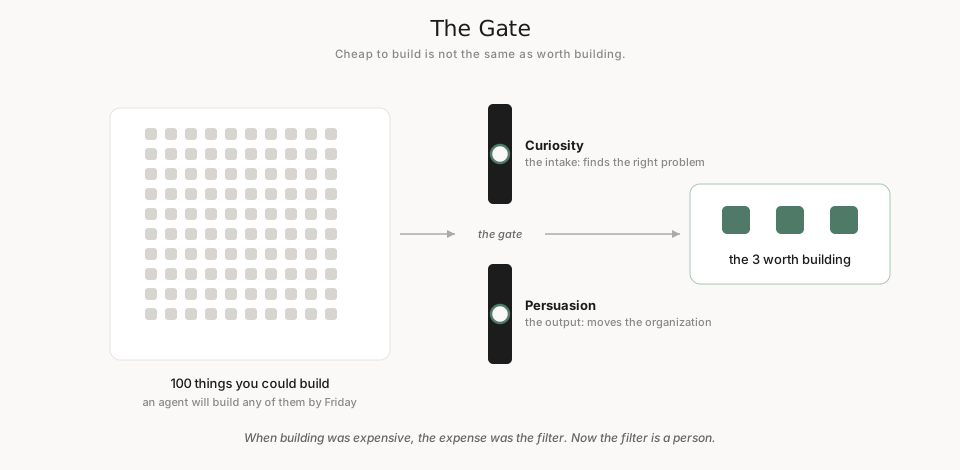
One hundred things you could build pass through a gate hinged on curiosity and persuasion. Three make it through.
The Gate Has Two Hinges
Gatekeeping the "should" runs on two skills, and they're a matched pair: one points inward at the problem, one points outward at the people.
Curiosity is the intake. Not trivia-curiosity. Investigative curiosity: the reflex to ask what question the request is actually hiding, to go find the evidence instead of accepting the summary, to sit with "why is this true?" longer than is comfortable. A curious professional doesn't take the request at face value; they ask who asked for it, what that person was trying to get done, and what the final outcome should be; they need to deeply understand the painful process and the radically good outcome in order to design a solution. Customers, managers, SMEs, will all tell you a feature they want; curious people will dig deeper. If you've been following my writing about "the scaling walls" at all, then it shouldn't be a surprise that curiosity is at the top of my list. Now that we can "hire" AI agents to help with certain tasks, curious product leaders need to look at the whole system and consider which work could be moved to agents entirely to radically change how the job is accomplished. Training yourself to think this way is a learned skill.
Incurious people plateau early and often don't know it. Curious people keep finding the next real problem, which is the single most employable habit that exists.
Persuasion is the output. You found the right problem; now you have to move an organization. That means building a case: assembling evidence, anticipating the strongest objection, writing the one-pager that a decision-maker can forward without you in the room. Persuasion has a sleazy reputation because we confuse it with manipulation. They're opposites. Manipulation works without evidence; persuasion is what evidence sounds like when a human takes responsibility for it. Persuasion is being armed with data, evidence, and clear thinking to make a case against other powerful people who have a differing opinion. Obviously, many other "soft" skills wrap into these: critical thinking, triage based on fixed points, and more. I think about this like building a case of truth to paint a picture that's hard to argue with. Being able to explain "why" clearly is a big part of it.
Side note: notice that AI is decent at the middle of this loop and weak at both ends. It will research what you tell it to research and draft what you tell it to draft. It will not notice that the client flinched at minute twelve of the call, and it cannot stand in front of your leadership team and spend its own credibility on a recommendation. The ends of the loop, the noticing and the convincing, are where the human value concentrates.
Check the Dates
You might be thinking this is a story reverse-engineered to make us feel better about the agents here in 2026. The basis for this article is a framework I created years ago for Anthroware. Other leaders much smarter than me have been prioritizing more than just hard skills for a long time.
In 2008, Google launched Project Oxygen. The premise was pure engineering culture: prove with data that managers don't matter, then flatten the org. The data didn't cooperate. The study identified eight behaviors shared by Google's best managers, and technical expertise came in dead last, eighth out of eight.1 The top of the list was coaching; communication and caring about people as people filled out the rest. Craft lost to the adjacencies inside the most engineering-proud company on earth, and the findings were public by 2013, years before the transformer paper existed, let alone ChatGPT.
In 2017, Harvard economist David Deming published the labor-market version of the same finding. From 1980 to 2012, jobs requiring strong social interaction grew by nearly 12 percentage points as a share of the U.S. workforce, while math-heavy, low-social jobs shrank.2 That same year, Deloitte ran the trend forward and forecast that soft-skill-intensive occupations would account for two-thirds of all jobs by 2030, up from half of all jobs in 2000.3
Then the AI wave hit, and the line didn't bend. It steepened. The World Economic Forum's 2025 employer survey puts analytical thinking at the top of the core-skill list (seven in ten employers call it essential), with curiosity and lifelong learning among the fastest risers.4 PwC's 2025 analysis of close to a billion job ads found skill requirements changing 66% faster in the occupations most exposed to AI, shifting toward exactly this judgment-and-communication cluster.5
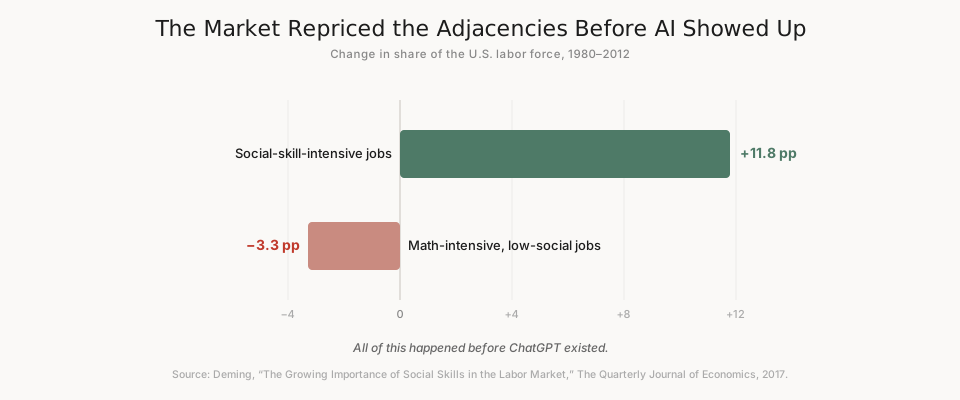
Social-skill-intensive jobs grew 11.8 percentage points as a share of the U.S. labor force from 1980–2012, while math-intensive, low-social jobs shrank 3.3 points.
Forty-five years of evidence, one direction. The market was repricing the adjacencies long before AI showed up; AI hit the gas.
The matrix below is how I've tracked those adjacencies for over a decade.
The Expectations & Impact Matrix
About 10 years ago at Anthroware, I created a tool for career conversations called the Expectations & Impact Matrix after seeing a similar document during a mentorship meeting with another (more successful) CEO. He wouldn't send me his file, and stated that it was important to go through the exercise myself; it has to be purpose-built for your company's culture. He was right. The version I'm sharing is adapted (not with AI) from the one I made 10 years ago. It's updated to be more generic. If you implement something like this for your career, or your team, it's worth going through the exercise of making your own.
One axis runs across five levels, Associate to Partner; everyone is treated like an emerging leader who is expected to progress through the 'Learn, Apply, Teach, Drive, Multiply' cycle. The other axis runs down twenty rows of skills, grouped into six bands.
The first band (Craft) is what I would consider the 'hard skills' section: technical depth, technical breadth, tools, process, and AI fluency. The other five bands are everything around it. To be a true professional, whether as a valued individual contributor or as someone who 'manages' a group of people, requires being a leader. There is a reason there's one band for craft and five bands for the adjacencies; the 'soft skills' are arguably the most important to hone in order to be a highly effective contributor. Things like curiosity and persuasion can't be faked. Finding the best solution (curiosity), being willing to be wrong when evidence points another way (humility), and building a case so that the best ideas win (trust building, persuasion, writing, communication, etc.) are the factors that truly bring value to a teammate.
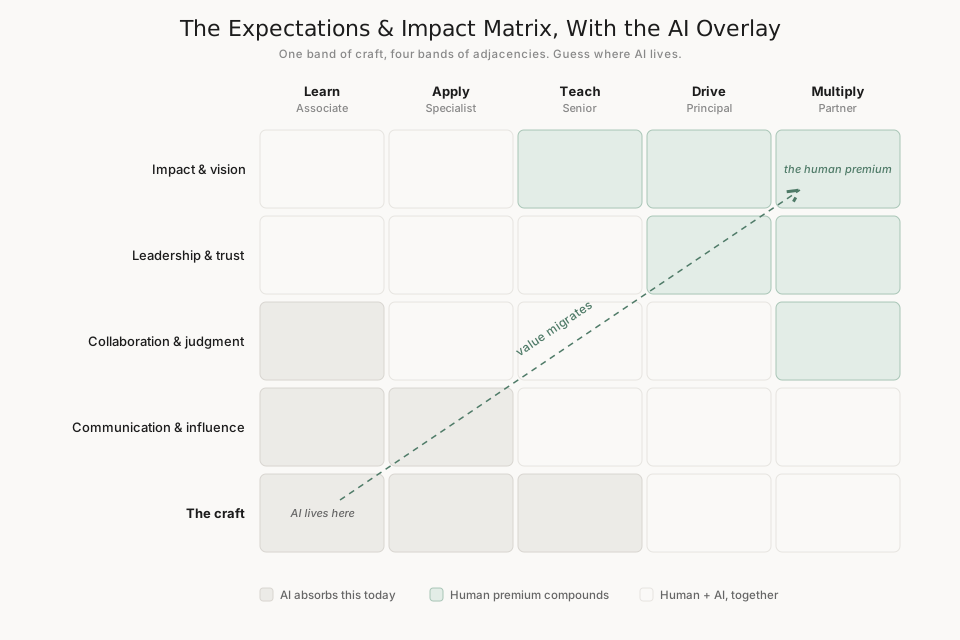
AI absorbs the lower-left cells of the matrix. The human premium compounds toward the upper right.
We didn't build the expectations matrix to make a point about AI; AI as we know it didn't exist. We built it because it matched what we kept observing in real people, real careers... our real team. As a leader I care deeply about the growth of my people, and regardless of whether they stay with my team, or move on, everyone in leadership should want to deliberately help their team succeed.
Culturally, our employees were so engaged with their personal expectations matrix that it replaced our yearly review. The mantra became "you are the CEO of your own career, and our job as leaders is to help you progress." The matrix made the deal concrete. Teammates kept their own copy, scored themselves, and brought it to 1:1s: "here are the rows I'm working on, here's where I think I've moved, what do you see?" The manager's job in that conversation was direct feedback in the moment, not a rating delivered eleven months after the fact. They were not always positive, but working on weak areas should be coached, not called out once a year like punishment. In the rare cases we had low performers, we had a record of that too, and could make the appropriate employment decisions with confidence.
It became a cultural thing. Career conversations stopped being an annual event run by HR and became a running dialogue owned by the person whose career it was. (Notice that's the curiosity-and-persuasion loop again: investigate your own gaps, then make the case for your own growth. The matrix was secretly a training ground for the two skills this whole post is about.)
Here's the AI overlay, and it's the reason I'm dusting this thing off in 2026. AI is very good at the bottom-left of the matrix: the early-level craft work, the drafts, the research runs, the grunt work. It is nearly useless at the top-right: the trust, the judgment, the rooms where the decision actually gets made. Which means the early craft rungs are compressing while the adjacency bands are appreciating. The matrix didn't change. The economy moved underneath it.
I cleaned up a de-branded, downloadable version of the matrix so you can score yourself against it: download the Expectations & Impact Matrix (PDF).
Practical Ways to Hone 'Soft' Skills
This stuff sounds abstract until you practice it on something live, so practice it on something live.
Take one request that landed on your desk this week. Before doing anything, write down the question you think the request is hiding; then go ask the requester two questions you can't answer from your desk. That's the curiosity rep. Then find two pieces of actual evidence (a number, a quote from a customer, a result from a quick test) and write a one-page case: here's the problem, here's the evidence, here's what I recommend, here's the strongest argument against me and why I still recommend it. Send it to someone who can say no.
That last sentence is the whole exercise. A case nobody can reject isn't a case; it's a diary entry.
Try it.
Do that loop ten times and you will be measurably better at the two skills this era needs and values, and you'll have ten one-pagers with your name on them. Nobody's agent did that. You did.
I'll add one more thing, because it's where my own conviction comes from. I believe we're designed for relationship, and made to create things. It has never sat right with me that we labeled the relational half of work "soft," as if it were the lesser half. The machines are taking the part of the job that made people act like machines. What's left is the human part, and it was always hard too.
Hope this helps. Reach out through the contact page if you'd like to talk about what this looks like for your team.