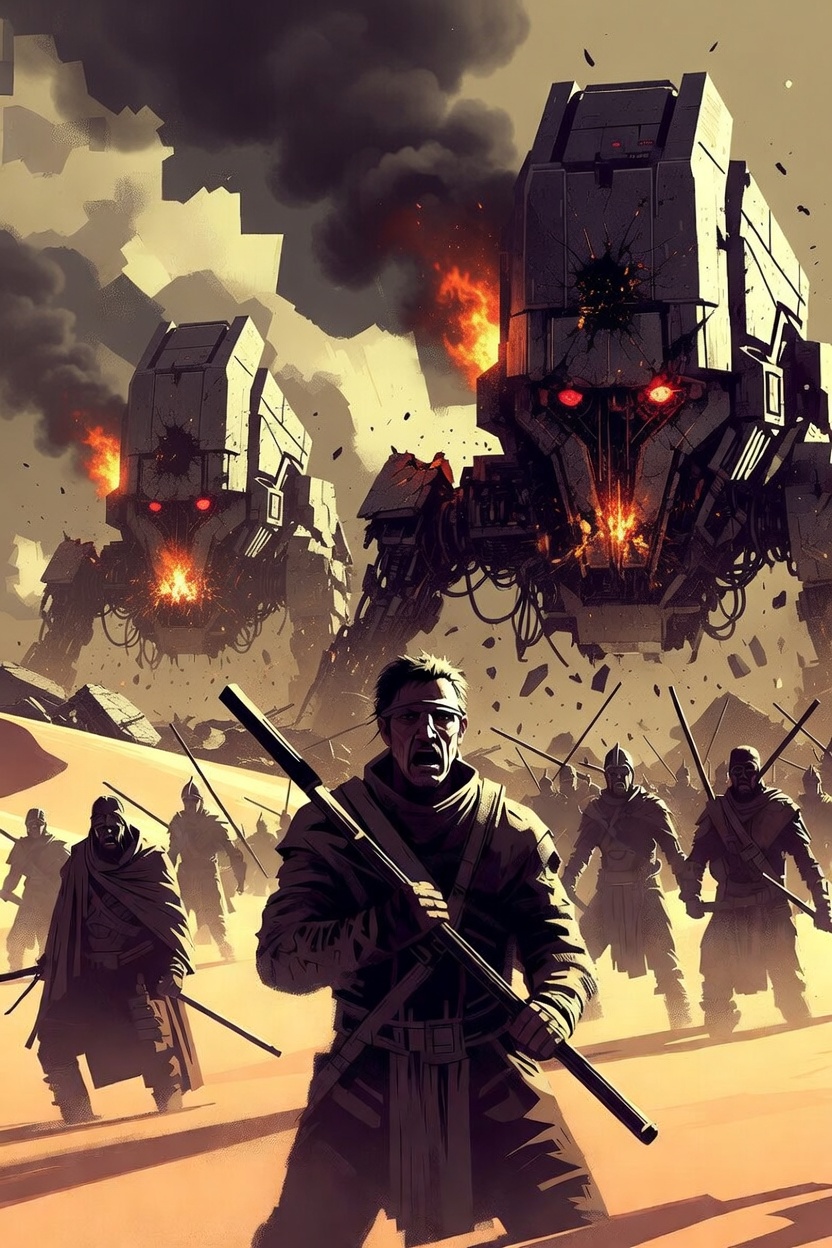
Ned Ludd's Ghost and the YouTube Algorithm
Ned Ludd never existed. The legendary weaver whose name became a movement was a fiction, pulled from a half-remembered 1779 story about an apprentice smashing stocking frames in Leicester. But in 1811, his ghost walked out of the Midlands and into history. English textile workers, gutted by the Napoleonic wartime economy and watching their trade collapse, signed their threatening letters "Ned Ludd" and started breaking machines.1
They were hanged for it. Seventeen at a single York sentencing in January 1813. Parliament made machine-breaking a capital offense. The Luddites lost, and we remember them mostly as a punchline; the word became shorthand for anyone fearful of progress.
Here's the part most people miss. The Luddites weren't opposed to machines in principle; most of them were skilled operators of machines. They were fighting mill owners who used new equipment to circumvent the labor standards that protected their wages and their craft. They were also right about what they saw coming. Wages did collapse. Craft knowledge was devalued. Entire villages were hollowed out. The transition was violent in both directions, and the industrial revolution remade British society in ways the workers of 1811 had no tools to resist.
Two hundred and fifteen years later, the fear is back. Not with hammers this time. With a sixteen-million-view YouTube interview titled "These Are The Only 5 Jobs That Will Remain In 2030!" and the tagline "WARNING: AI could end humanity, and we're completely unprepared." The BBC has eleven million views on "Is this how AI might destroy humanity?" Tom Bilyeu has 620K on "If You Don't Have One of These Jobs by 2030… You're Screwed." My algorithm served me "Yes, AI Will Take Your Job. But What Happens NEXT Is Worse" the other morning while I drank coffee.2
Luddite clubs are forming on college campuses. Gen Z is trading smartphones for flip phones. CNN and The Nation are writing about the "Luddite Renaissance".3 The neo-Luddites aren't hammering anything; they're unplugging. But the fear underneath their movement and the fear underneath those YouTube headlines is the same fear the 1811 weavers felt. The machines are coming, and the people on the other side of them don't care what happens to us.
But here's how that ended. The machines the Luddites feared made possible a world where you can buy a mass-produced Tesla Model 3, a car wildly better than anything the 1811 weavers could have imagined, AND still commission a Bugatti La Voiture Noire, a one-of-one hand-finished by craftsmen who inherited their trade from the same industrial revolution that obliterated their ancestors' craft. Abundance made both things possible. Not one or the other. Both.
Gene Roddenberry's Star Trek put this idea in uniform. In the 24th century, replicators generate a perfect bowl of gumbo in seconds. Captain Sisko's father still runs a packed Creole restaurant in New Orleans, because the work a human puts into a meal is still the part that matters. Replicators didn't end the restaurant business. They freed it from the commissary line.
Are the experts telling you 90% of jobs will be gone forever all wrong?
That's the question this piece is built around. I'm not going to tell you the answer. I'm going to hand you a framework and 51 careers analyzed through it, and let you decide for yourself.
The Wrong Question and the Right One
Earlier this year I sat down to build a career disruption matrix. You know the kind: list of jobs, risk ratings, scary red arrows pointing down. I pulled from BLS, Goldman Sachs, McKinsey, the World Economic Forum. The first version looked exactly like every other AI report you've read. Radiologists: high risk. Paralegals: extreme. Software engineers: better learn a trade.
It was polished. It was well-sourced. And I couldn't shake the feeling it was answering the wrong question.
Every one of those risk ratings answered the same thing: "How much of this job can AI do?" That sounds reasonable. It produces wildly misleading answers for most of the service economy.
So I threw version one out and started over with a different question. Not "how much can AI do?" but "what happens when AI absorbs the overhead surrounding this job, and there's a massive pool of unmet demand on the other side?"
The answer changed everything. Careers I'd rated as high-risk flipped to amplified. Careers I'd assumed were safe turned out to be in real trouble. The overall picture looks nothing like the mass-displacement story dominating the news cycle.
If you've been reading my work on the scaling wall, this is where the framework meets the data. If you haven't, start with the original post and come back; it's a quicker read than this one.
Here's what I'm putting in your hands:
- A two-axis framework (overhead exposure by scaling wall strength) that gives you a way to reason about any role, not just the 51 I scored.
- 51 careers analyzed, scored, and placed in one of four quadrants, with a Signal column (GOOD / PIVOT / DANGER) for at-a-glance reading.
- The specific places where this analysis disagrees with the prevailing narrative, with the primary-source data behind each call.
- 45 citations from BLS, AAMC, HRSA, LSC, NCES, NN/G, Northwestern, IMF, and peer-reviewed labor research.
Your move after that is yours. I'll show you what I see; you decide what to do with it.
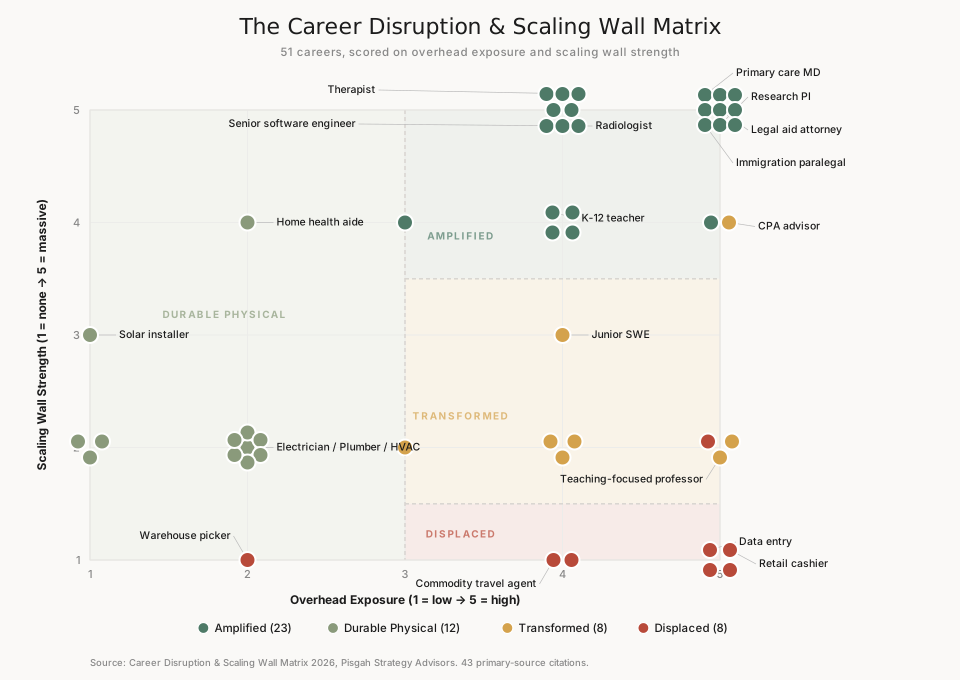
51 careers scored on two axes. Overhead Exposure (how much of the job is administrative weight AI can absorb) and Scaling Wall Strength (how much unmet demand sits behind the bottleneck). Green = Amplified. Sage = Durable Physical. Amber = Transformed. Red = Displaced.
ATMs, Radiologists, and the Jevons Paradox
The most interesting part of the matrix isn't the easy calls. It's the careers where the scaling wall framework reaches the opposite conclusion from the conventional take. Four examples, one of which most readers have already lived through without noticing.
Start with the one you've lived through. In 1967, banks rolled out the first automated teller machines and braced for the layoffs. Trade press wrote obituaries for the profession. Over the next forty years, four hundred thousand ATMs went into service across the United States. And teller employment grew, from roughly 500,000 in 1980 to nearly 600,000 by 2010. Economist James Bessen figured out why. ATMs made branches cheaper to operate, so banks opened more of them. Tellers per branch fell from 20 to 13. The number of urban branches jumped 43%. The remaining teller work became more relationship-oriented and higher-margin, with tellers selling financial services instead of just counting cash.4
Economists have a name for this. In 1865, William Stanley Jevons observed that James Watt's more efficient steam engine didn't reduce England's coal consumption; it increased it, because cheaper energy per unit made entirely new uses economically viable. Resistance dropped, demand flooded in. Jevons called it a paradox. Economists now call it the Jevons Paradox, and it has held up for 160 years across coal, computing, bandwidth, and storage.16 The ATM story is Jevons applied to banking. The scaling wall framework is Jevons applied to AI and the service economy: when AI collapses the overhead cost of delivering a service, the result isn't fewer practitioners. It's more demand than the profession has ever seen.
The ATM story isn't a claim that "technology never displaces workers." It's a claim that "will this machine replace this worker?" is almost always the wrong question. The right question is "what happens when the cost of delivering this service collapses, and there are people who couldn't afford it before?"
Now hold that question in your head while you look at three careers everyone assumes they already understand.
The Radiologist. If you've read any AI career report in the last five years, you've seen radiologists listed as high-risk. Geoffrey Hinton's 2016 quote ("We should stop training radiologists now") became gospel. Here's what the data actually says.
There are approximately 41,000 radiologists in the United States.5 Imaging volume is growing at 4.6% per year. The workforce is growing at 1%. Only 29 new PGY-1 residency positions have been added nationally in four years. The average CT exam has grown from 82 images to 679 images per study; radiologists now interpret one image every 3-4 seconds for eight hours straight.6
There is no replacement scenario that makes mathematical sense. Northwestern's 11-hospital study of 24,000 reports showed AI-assisted reporting improves efficiency 15-40%.7 That means 10 radiologists doing the work of 12-14, which absorbs seven years of volume growth without hiring radiologists who simply do not exist. The radiologist isn't being replaced. The radiologist is being amplified against a volume wall that was going to break the profession within a decade.
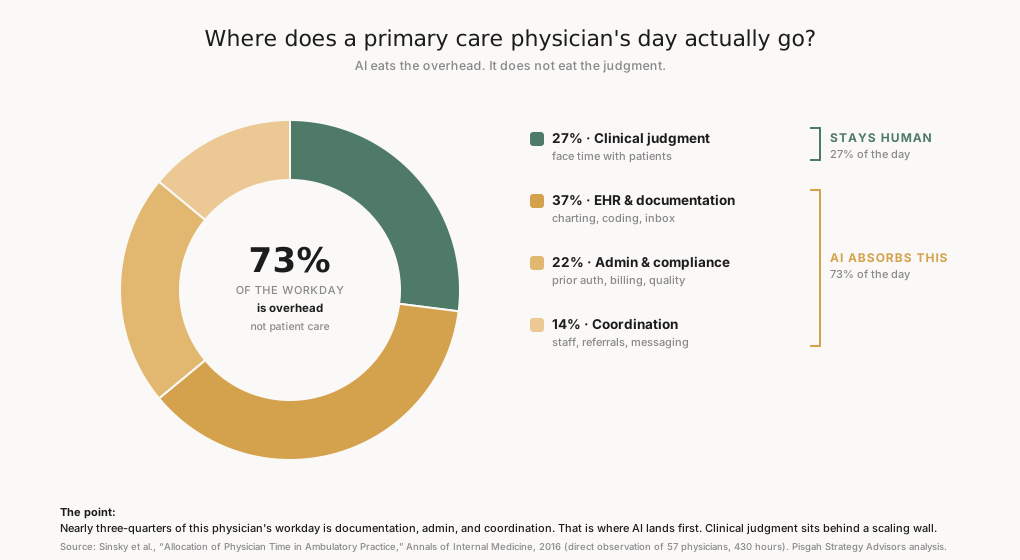
Where a primary care physician's day actually goes. Data: Sinsky et al., Annals of Internal Medicine, 2016.
The College Professor. This one cuts the other way. Most people assume tenured professors are safe. The matrix says it depends entirely on whether you're teaching or researching.
Teaching-focused faculty at non-selective institutions face compounding pressure. The enrollment cliff hits this fall. The 18-year-old population peaks at roughly 3.9 million in 2025, then declines through 2040. The Northeast and Midwest see 15%+ drops by 2029.8 The share of high school graduates going straight to college has already fallen from 70% to 62% since 2016. Compound that with AI absorbing lectures, grading, and routine Q&A, and the business model is under real structural pressure. Unlike K-12 teachers (who sit behind a genuine scaling wall of compulsory attendance, developmental need, and a 400,000-position vacancy crisis9), higher ed's "demand" is largely credentialing. And credentialing is exactly what AI threatens.
Research-focused professors and principal investigators, on the other hand, land squarely in the Amplified quadrant. Frontier knowledge is the ultimate scaling wall. Grant writing alone eats 20-30% of a PI's year. Researchers using AlphaFold 2 submit 40%+ more novel protein structures; their papers are twice as likely to be cited clinically. The two lead authors won the 2024 Nobel Prize in Chemistry.10
Same job title. Opposite quadrants. I split "college professor" into two rows in the matrix to make that tension visible.
The Software Engineer. Everyone "knows" coders are getting replaced, right? The matrix says it depends on the tier. Junior software developers land in Transformed; the entry rung contracts as AI absorbs boilerplate, tests, documentation, and routine refactors. But senior and staff engineers land in Amplified with a scaling wall score of 5 out of 5.
Why? The global software backlog is essentially infinite. Most businesses are priced out of custom software. Legacy modernization is bottlenecked by developer supply, not budget. When a senior engineer becomes 3-10x more productive, projects that were previously unaffordable become possible. The constraint shifts from "can we build this?" to "can we decide what to build?" That last question, by the way, is why Product Manager also lands in the Amplified quadrant, along with UX Researcher. The disciplines that seemed most vulnerable to AI are actually the ones with the deepest unmet demand behind them.11
The senior engineer plus AI is Tony Stark plus Jarvis. Stark doesn't stop designing; Jarvis doesn't start inventing. The human does the creative work and the judgment; the AI handles the computation, the lookup, the boilerplate, the "run the sims overnight while I sleep." The result is one person capable of building what used to take a team.
The Paralegal. This one's the clearest single illustration of the reframe. I list "paralegal" in two different quadrants. Immigration paralegals at legal aid organizations (where 92% of civil legal needs go unserved12) land in Amplified. Big-firm document-review paralegals (where the work is billable overhead, not unmet need) land in Displaced. Same job title. Different demand on the other side. Completely different future.
Every Scaling Wall Needs a Shovel
One quadrant deserves its own mention. The 12 Durable Physical careers are entering what I'm calling a decade-plus golden age. The drivers: $1.4 trillion in data center investment by 2030, $10 trillion in power grid modernization, a construction labor shortage that costs $10.8 billion per year in lost home production, and the fact that humanoid robots are currently 200,000 times less capable than what skilled trades work actually requires.13 14
This is more than a defense-of-trades argument. Every other industry the AI wave unlocks creates more demand for trades. More therapists means more clinics. Teachers fill more schools. Data centers need more electricians and HVAC techs. Trades don't just survive the AI era. They're a direct beneficiary of every scaling wall that comes down.
43 Out of 51
43 of 51 careers in the matrix (84%) land GOOD or PIVOT. Eight contract.
That doesn't make displacement fake. The eight are real: data entry clerk, retail cashier, telemarketer, claims processor, basic bookkeeper, tier-1 customer service rep, warehouse picker, commodity travel agent. Those are real jobs held by real people, and the transition deserves to be taken seriously.15
But the other 43? Either amplified by AI (the wall comes down and demand floods in), protected by physics (the trades), or transforming in ways where the senior tier expands even as the junior tier contracts.
The story isn't "AI replaces your job." The story is "AI changes what your job is for."
Roddenberry's Bet
Every scaling wall that comes down lets humans do something that used to be impossible.
Research scientists finally able to read every relevant paper before writing a grant, not just the ones their coauthors already knew. Cancer researchers running millions of simulated protein folds in an afternoon instead of a career. Therapists serving ten times the patients they can serve today. Engineers designing fusion reactors with simulations that used to take a supercomputer a year. Oceanographers sending robots into trenches we've only mapped at the resolution of the moon's surface. Construction robots working in radiation zones, demolition sites, and disaster areas where humans shouldn't be. Eventually, humans building infrastructure off-planet because the work is finally tractable.
This is the Roddenberry version of the argument, and it's not naive. It's what happens every time a technology breaks a scarcity that's been holding a field back. Penicillin unlocked modern surgery. The steam engine gave us cities. The integrated circuit is behind everything you've touched today. AI brings down the scaling walls on service, on science, on where humans can physically go and what we can physically build. The end state isn't fewer jobs; it's more interesting ones.
The Luddites got cars and antibiotics and the ability to talk to anyone on Earth from their pocket. That was the deal. This round, if we're wise, the deal gets even better.
Check My Work
Fair question. The internet is full of frameworks that feel smart for forty minutes and fall apart under any real weight.
Two things you can check for yourself.
The sources. 45 primary citations. BLS occupational projections. AAMC and Neiman radiologist workforce data. HRSA and the Learning Policy Institute on teacher shortages. The Legal Services Corporation on the civil justice gap. NCES and WICHE on the enrollment cliff. NN/G on UX reckoning data. Northwestern's AlphaFold study. Bessen's ATM research. Acemoglu's NBER macro analysis. Eloundou, Manning, Mishkin, and Rock's GPTs-are-GPTs paper. Every number in the matrix links back to a named source you can read yourself.
The disagreements. A good framework makes predictions you can argue with. This one does. It says radiologists will not be replaced; go check the residency match data in three years. It says entry-level software developer employment will compress while senior developer compensation expands; pull the BLS numbers in 2028 and see. It says the enrollment cliff plus credentialing pressure will force a hard consolidation in non-selective higher ed; watch the next five years of closures. If I'm wrong, the data will tell you. I'd rather publish something falsifiable than something safe.
The framework is also doing work outside this matrix. I've been thinking about the scaling wall for about three months now, and the thing I didn't expect was how often it reframes decisions that don't look like AI questions at all: how to price a service, which customer segment to chase, where to hire during a downturn. The 51-career matrix is one application. It isn't the only one.
Make It So
I've published the complete 51-career matrix as a downloadable whitepaper. It includes the full two-axis framework, all 51 careers scored and analyzed by quadrant, a dedicated section on where this analysis disagrees with conventional wisdom, the trades golden age thesis, and all 45 primary-source citations.
Download the 2026 Career Disruption & Scaling Wall Matrix →
Whether you're a career changer figuring out which way to move, a parent helping a kid think about what to study, or a business leader deciding which roles to invest in versus restructure, the matrix is built for all three of you.
Then do three things with it.
Go play with the tools. If you've never actually sat down with Claude Cowork, NotebookLM, or Replit and watched them eat four hours of your week, you are arguing about a technology you have not used. That was a move the Luddites of 1811 could not have made; they only got to watch the machines from the other side of a locked factory door. You do have the privilege. Pick a task you dread. Give it to Claude. Drop a research project into NotebookLM. Build something small in Replit. Every person I know who has done this has come out with a different story about AI than the one they had going in.
Go look for your own use cases. The matrix is a starting point, not a verdict. Maybe your job isn't one of the 51. Maybe your role is one of the 51 but the job you actually do inside that role bears no resemblance to the average. That's fine. The framework still works. Two axes, four quadrants, the question of what's behind the scaling wall. Apply it to your own work. If you land in Amplified, start building the habits now. If you land in Transformed, decide which tier you want to be in. If you land in Displaced, start looking sideways (and the matrix has plenty of neighboring careers to consider).
Share this with someone who's scared. This is a big change. Bigger than the internet, bigger than the smartphone, probably comparable to what electricity did to the household. The people in your life who are afraid of AI are afraid for reasons worth respecting. Give them a framework they can reason with instead of headlines designed to panic them. Fear that has somewhere to go becomes planning. Fear that doesn't becomes paralysis.
One last thing. History shows the Luddites could not foresee how the Industrial Revolution would ultimately unfold. Neither can we predict the full arc of this AI era. What we do know is that humanity has navigated every technological transition before, often emerging stronger. The productive posture is not fear but focused action: build, serve your customers and colleagues, create useful things. The machines are here. The distinctly human work of imagining, caring, and innovating is not going anywhere.
Hope this helps. Reach out through the contact page if you'd like to talk about what this looks like for your career or your organization specifically.