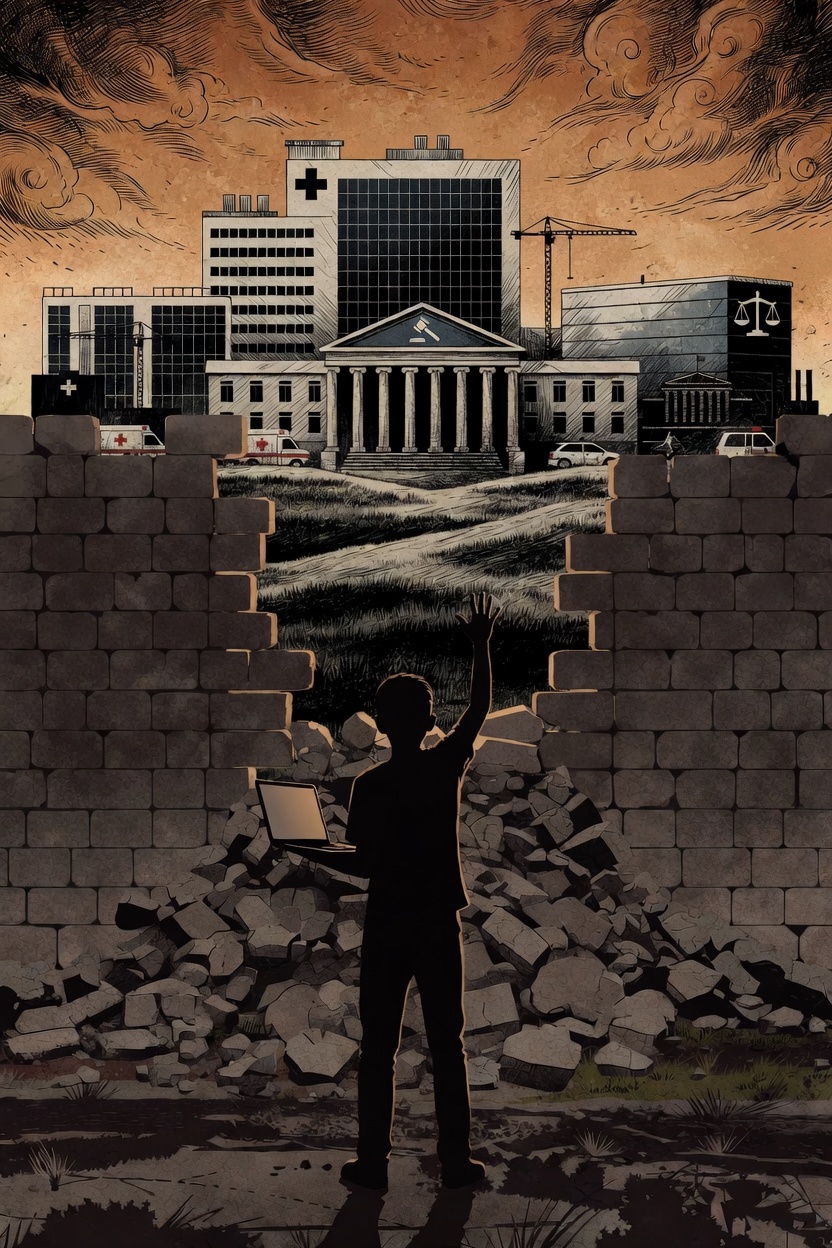
This is Part 3 of a three-part series. Part 1 made the macro case (software is still eating the world; the layoffs are a correction wearing an AI costume; the cost of building just collapsed). Part 2 walked through the new operating model (the bridge crew, the editor-in-chief role, why judgment becomes the moat). This part is direct address to the reader, especially anyone early in their career and watching the headlines.
The story right now is that juniors are the canary in the AI coal mine. Entry-level positions are vanishing. The bottom rung of the ladder is gone, the argument goes, because AI does what juniors used to do, and nobody pays a salary for what a model will do for free. If you graduated from a CS program in 2024 or 2025, you're hearing this from every direction. Your former classmates who landed offers in 2022 are getting laid off. Your professors are advising you to pivot. The panic is real.
We have heard this exact prediction three times in the last twenty-five years. Each time, the cover story was different. Each time, the prediction was wrong.
Three Squeezes, Three Recoveries
Round one was the dot-com bust. In 2001 and 2002, the same kids who had multi-offer bidding wars in 1999 walked into rescinded offers and frozen pipelines. CS bachelor's degrees in the US fell from roughly 60,000 in 2004 to under 40,000 by 2009 as undergrads steered away from the major in droves.1 Computer science was a "dying field." Then came Google, Facebook, AWS, the iPhone, and the entire mobile and cloud era. The cohort that stayed in CS through the down years became the most successful generation of engineers in modern tech, because they had time to learn fundamentals deeply, and they came up the ladder right when the industry needed them most.
Round two was the 2008-2009 financial crisis. Tech weathered it better than finance, but CS grads who had banked on Goldman or McKinsey watched those tracks collapse. The "lost cohort" narrative was real for that subset. Most of them pivoted to startups, grad school, or the tech firms still hiring. Within three years, the post-2010 mobile and app store boom had absorbed them, and most ended up better off than the classmates who had taken the safer finance path.
Round three is right now. Same panic, same headlines, same predictions. The cover story is AI this time, instead of bubbles or financial crises.
Three Squeezes, Three Recoveries
U.S. tech employment from 2000 to 2025. Each dip looked like the end. None of them were. (The 2022-2024 rate-hike correction unwound the zero-interest-rate era that had inflated tech hiring.)
Source: BLS Occupational Employment Statistics, computer and mathematical occupations.2 Indexed to 2000 = 100.
The pattern repeats across all three rounds. A correction creates a hiring pause. The pause lasts roughly eighteen to thirty-six months. Then a new wave of demand opens up, and the cohort that survived the pause is dramatically more valuable than the one that came up the ladder during the easy years. The reason isn't sentimental. It's that surviving a hiring squeeze forces a junior to learn to ship without supervision, prove value before being asked, and build something real instead of cruising on a brand-name employer. Those are the people who become senior engineers. Those are the people who become founders. The hiring squeeze is brutal in the moment and clarifying in retrospect.
Now, what is different this time. I'm not going to pretend AI changes nothing. AI is genuinely deleting work. Not making the boilerplate faster, deleting it. The "go figure out this API," the "translate this spec into code," the rote pattern-matching, the form-filling, the repetitive review. That work is going, completely, not being optimized. The shape of the junior job is changing. What's changing is which tasks live inside it.
Tasks vs. Jobs
This is the most important shift in how to think about AI and your career, and it's the lens that makes everything else clearer: AI does not delete jobs. It deletes tasks.
A job is a bundle of tasks. Always has been. A primary care doctor doesn't have one job; she has thirty different micro-tasks across a day: charting, reviewing, examining, diagnosing, calling, prescribing, billing, documenting. Each of those is a task. The bundle is the job.
What AI is actually doing, in every industry it touches, is reaching into those bundles and deleting tasks. Not jobs. Tasks. Specifically, the rote, repetitive, mechanical ones that don't require human judgment. The chart review. The first-draft brief. The submittal review. The form-filling. The data wrangling. The boilerplate. AI is great at all of those, and it's getting better fast.
What it can't do is the part of any job that lives in human judgment: the diagnosis, the strategy, the customer relationship, the call about whether something is good. Those tasks stay. They become a larger share of the day, not because the day is any shorter, but because the deletable tasks just disappeared.
So the question for any worker, any team lead, any founder looking at any job is no longer "will AI take this?" The question is: which tasks inside this job are deletable, which are hybrid (AI does a first pass, a human reviews and signs off), and which are retained? That's a different question. It's specific, actionable and it changes everything about how you read the news, plan your career, or build a product team.
This is the new senior skill in software, and it travels. Anyone who can walk into a job they've never done before, watch someone do that job for a day, and produce a ranked list of which tasks could be deleted entirely, which are hybrid candidates, and which are retained — that person is going to be unbelievably valuable for the next decade. Not just in tech. In every industry that's been waiting for software to actually arrive.
Asking "why are we doing this?" is the junior varsity move. The varsity move goes further: which parts of this person's entire day can we delete from their workload, completely, by handing them to agents?
The Two Skills
If you're early in your career and trying to figure out where to invest your time, the temptation is to pick a lane. Become a great engineer. Become a great designer. Become a great product manager. That worked when the lanes were sharply defined. They're not anymore.
The juniors who win this decade will develop two skills in parallel, and neither one is optional.
The first is technical editor-in-chief. Not writing the boilerplate yourself — the agents will do that — but reading code and architecture well enough to know when the agent's output is correct, when it's subtly wrong, and when the system underneath is going to bend in six months. You don't have to write every line; you have to understand the system. Architectural judgment, integration sense, an eye for what good engineering looks like at a glance. Working at a higher level of abstraction, but with the depth to know when something is off.
The second is the deletion lens paired with critical "why" thinking. Understanding that the new value creation isn't shipping more features. It's identifying which tasks shouldn't exist anymore. Asking why obsessively. Talking to customers obsessively. Knowing the difference between a real painkiller and another vitamin. This is the product and strategy side of the job, and it travels across every industry.
Neither skill alone is enough. A technical editor-in-chief without the "why" builds beautiful systems nobody needs. A product strategist without technical depth can't tell when the agent has shipped something broken. The juniors who develop both — and they are both learnable — are the ones who run small teams in five years, and build companies in ten.
Where the Deletable Work Lives
The industries with the biggest opportunity right now are the ones I've been writing about for months. They are the industries sitting behind Baumol's scaling wall. They share a structural feature: a huge percentage of the daily workload is overhead. Documentation, paperwork, mechanical review, form-filling, triage, scheduling. Tasks that humans are doing because no machine could, until now.
Look at primary care. A landmark time-and-motion study found that physicians spend roughly 27% of their day in direct patient care and 49% on EHR and desk work — for every hour with a patient, nearly two more on documentation.3 On top of that, the 2024 AMA Prior Authorization Survey found physicians and their staff spend an average of 13 hours per week and complete 39 prior authorization requests per physician per week.4 Most of that workload is deletable. The diagnosis, the patient relationship, the treatment decision — those stay. Everything else: rendered, often, by an AI agent the doctor reviews and signs off on.
Look at law. Goldman Sachs estimated up to 44% of all legal tasks could be automated, and up to 74% of hourly billable tasks specifically, including information gathering and data analysis.5 A 2024 Thomson Reuters report found that over 40% of tasks typically performed by junior associates — document review, contract drafting, preliminary due diligence — show meaningful susceptibility to AI-assisted automation.6 What's left for the associate is client counseling, strategy, and the judgment that comes from years of practice. The hours of the week change shape. The seat doesn't disappear.
Look at construction project management. Industry research finds that mid-size contractors spend roughly 22 to 28% of project-coordination labor on document-management tasks, and a typical $50M general contractor loses over 330 hours of PM and PE time annually to manual RFI and submittal processing.7 The remaining time is jobsite judgment, trade coordination, problem-solving when something on the drawings doesn't fit. The deletable share is the difference between a PM who runs one project and a PM who runs three.
Anatomy of a Job: Most Tasks Are Deletable
Three jobs broken into their daily tasks, color-coded by what AI can absorb versus what stays human. The deletable + hybrid bands are the opportunity.
Sources: Sinsky et al. (2016)3; AMA Prior Authorization Survey (2024)4; Goldman Sachs/Thomson Reuters research on legal task automation5,6; construction industry submittal/RFI productivity studies.7 Task distributions are illustrative approximations; specific percentages are estimates, not precise time-and-motion measurements.
Add education administration, agricultural inspection, insurance underwriting, municipal permitting, manufacturing operations, hospitality back-office. Each one is a scaling wall industry sitting on a pile of deletable tasks that humans are doing because no software was ever good enough to do them. Now the software is good enough.
That's where the work is going. Not vanishing. Moving. And the people who walk into these industries with the deletion lens, who can sit with a practitioner for an afternoon and identify the half of their day that could be handed to an agent, are going to be the most valuable hires of the next decade.
Taste Is The Moat
Knowing what to delete is half the skill. Knowing what to build is the other half.
Volume is no longer scarce. Anyone with an AI subscription can ship features. So the moat moves up the value chain: into taste, judgment, customer empathy. The discipline to look at a thousand things your agents could build and pick the one that actually solves a real problem.
I've been making this point for years and I'll lean on the same metaphor I always do. A list of ingredients is not a meal. A pile of features is not a product. AI just handed every team in the world an infinite pantry; the teams that win are going to be the ones with the best chef.
So how do you become the best chef? You start with a real job to be done — not a feature on a backlog, but the actual task a real person is trying to accomplish in their actual life. You figure out whether the pain is a painkiller (acute, frequent) or a vitamin (mild, occasional). Painkillers get adopted. Vitamins get nodded at and ignored.
Painkiller or Vitamin?
The two questions that matter: how often does the user hit this pain, and how acute is it? Build for the top right. Ignore the bottom left.
Adapted from Jon Jones, "Business Model Pressure Test," Anthroware (c. 2014).8 Examples illustrative.
Then you ask "why" early and often. Why is this person doing the task this way? Why has nobody fixed it yet? Why would they switch? Why now? When you can answer those questions for a specific person, with confidence, you can credibly mark each task in their workflow as deletable, hybrid, or retained — and give your team of agents a direction worth executing on.
This is the part you should pour your time into, especially if you're early in your career and watching the headlines and wondering what the play is. The play isn't to write more code than the next person; the agents will out-write you. The play is to exercise sharper judgment, faster, on the right problems. Talk to customers. Watch them work. Learn what hurts. Learn which parts of their day shouldn't exist anymore. The agents will build whatever you tell them to, and absorb whatever you tell them to absorb. Make sure both decisions serve a real person on the other end.
On the flipside of this, we're going to see a lot of crap get built just because AI makes it easy. The skill of knowing what to build is going to be scarce and important.
What To Do This Week
If you're early in your career and watching the headlines, the smartest thing you can do this week is start practicing the deletion lens. It's a muscle. You build it by using it.
Here are five things to do, in rough order.
1. Pick an industry and shadow someone for half a day. Healthcare, law, construction management, insurance, education administration — any of them. Find one person doing their actual job. Sit beside them, watch what they do, take notes. Don't pitch them anything. Just watch. The goal is to see the workflow in detail.
2. Make a task list for the day you observed. Every distinct activity the person did, listed out. Don't editorialize yet. Just list. Most jobs have thirty to fifty distinct tasks in a normal day, and most people who work those jobs have never sat down and counted them.
3. Color each task. Deletable (could be handed entirely to an AI agent without losing quality), hybrid (AI does a first pass, the human reviews and signs off), retained (requires human judgment, irreplaceable). You'll be wrong about half of them at first. That's fine. You'll get sharper.
4. Find one task to build something around. Pick a single deletable or hybrid task that touches a lot of people in this industry. Talk to two more practitioners and confirm that yes, this task is real, painful, and frequent. Now you have a problem worth working on. Build a rough prototype with AI agents. Show it to the people you talked to. See what they say.
5. Get reps. By the time you've done this a few times, you'll see software opportunities everywhere, and you'll be able to give clear, structured direction to a team of agents in a way that ninety percent of people in tech right now cannot. They haven't been trained to.
Research industries with obvious scaling walls — technological or human bottlenecks — and ask what data you'd need to feel good about an AI agent making an important judgment call. Companies and careers will be built around instrumenting these workflows to produce the data needed to "feed" the agents.
One thing not to do: do not spend the next six months getting certified on AI tools. The tools change every quarter. The seeing-what-to-delete skill compounds for decades. Invest in the part of yourself that compounds.
Where You Come In
So, software is still eating the world. The half it's eaten so far was the easy half. The half it hasn't is sitting behind a wall that just got dramatically lower. The work isn't disappearing. It's getting distributed. Five megacorps don't have to dominate when five thousand small teams can each build something great. What's changing isn't the work; it's the kind of work, and the change is in our favor. Less code monkey, more captain. Less spec execution, more taste. Less syntax wrangling, more time spent on what's worth making and who it's for.
If you build software for a living, the headlines are not the story. The story is that the most interesting moment in this industry's history is just starting, and the people who lean in now are the ones who are going to be running teams, building products, and shipping real things to real people in five years. They always are.
If you're a junior reading this, the play is both skills in parallel: technical editor-in-chief (knowing when the agent's output is wrong, even if you didn't write it) and the deletion lens (knowing which tasks shouldn't exist anymore). Talk to customers. Watch them work. Learn what hurts. The agents will out-write you; make sure what you're telling them to write is worth writing, and what you're handing them to absorb is worth being absorbed. Developers are moving a lot closer to being product designers; product designers are moving a lot closer to shipping code; both are moving closer to the customer.
If you're a senior, the play is to become the editor-in-chief you were going to become anyway, but a decade earlier than expected. Pour your time into the things AI can't do: the why, the customer empathy, the painkiller-vs-vitamin call, the discipline of saying no.
If you're a founder, this is the cheapest moment in software history to start something that matters. Go.
The bridge chair has your name on it. Make it so.
Hope this helps. Reach out through the contact page if you'd like to talk about what this looks like in your industry, your team, or your career.
The Make It So Series
- Part 1 — Software Is Still Eating the World
- Part 2 — Make It So: The New Operating Model
- Part 3 — Hope for the Junior: How to Win in This Era (you are here)